Greece Index
Find Places of Interest, Hotels, Apartments, Restaurants, Car Rental and Services in Greece
Greece Index
Find Places of Interest, Hotels, Apartments, Restaurants, Car Rental and Services in Greece
Greek Language History
Most people know about Ancient Greek, the language used by famous thinkers and writers long ago. But do you know how it changed into the Greek language we hear in Athens and other areas of Greece today? The history of the Greek language began with the classical version used by the ancient Greeks, went through changes during the Byzantine period, and later evolved into Katharevousa. Finally, a more common form known as Demotic Greek became popular. Each period in history left its mark on the language, creating the modern Greek that is still in use today.
Greek language is spoken by approximately 10 million people. It is also one of the official languages of Cyprus, where there are an additional 600,000 speakers. Beyond that, some 3-4 million people elsewhere in the world claim Greek as their first language, including speakers in Turkey, Albania, Canada, and the United States. Greek has been one of the official languages of the European Union since 1981.
Table of Contents

History of the Greek Language
The Greek language has a rich history that spans over 3,000 years, making it one of the oldest languages still spoken in Europe. It began with the Linear B script used by the Mycenaean civilization and has evolved into the language spoken in Athens today.
Greek played a major role in shaping Western culture, including philosophy and science. Its alphabet was revolutionary because it was one of the first to include vowels, making reading and writing easier to learn.
Many English words, especially in medicine and science, come from Greek. But it’s not just words – Greek has also given us many ideas that have influenced Western thought.
Greek Language was the defining feature of Greek culture. If you spoke fluent Greek and were conversant with the basic features of Greek culture, you were considered to be Greek, regardless of your homeland or physical features. But Greek was not a uniform language. There were scores of dialects even within the tiny geographical area of mainland Greece. Ancient Greeks spoke in different ways from place to place so there were many Greek dialects.
Ancient Greek Language
The Greek language has a long and fascinating history. It really came into its own during the Classical period, when Ancient Greek language and culture had a huge impact on the development of the Western world. Understanding the early stages of the Greek language helps us appreciate its deep roots and lasting influence on today’s languages.
Linear A and B
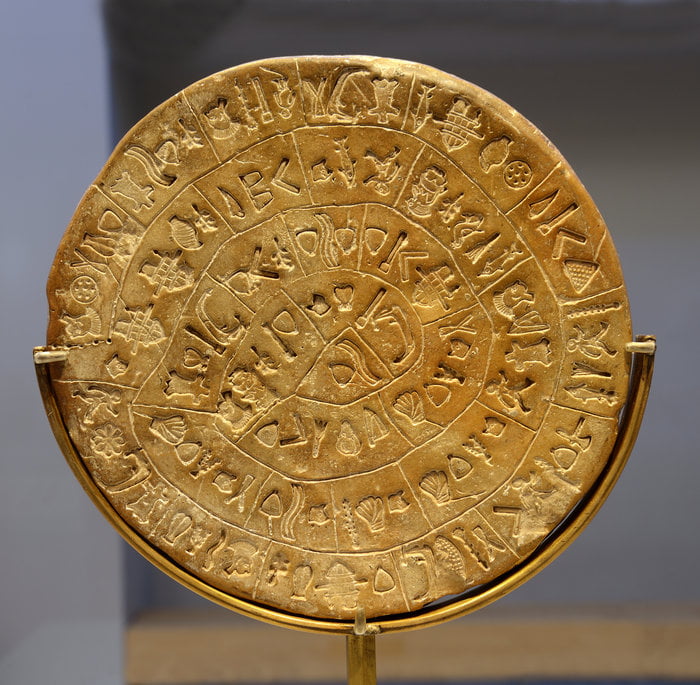
The intriguing Linear A and B scripts are some of the earliest forms of Greek writing. Linear A is a still unsolved mystery left behind by the ancient Minoans. It was probably used for religious rituals and keeping track of things, but since we can’t translate it, there’s a lot we don’t know about the early Greeks. Phaistos Disc is a famous example of Linear A script.
Linear B, on the other hand, was figured out by Michael Ventris in the 1950s after it was found by archaeologist Arthur Evans. This script is closely related to the Greek language and helps us understand the Mycenaeans, who lived over 3,000 years ago. We find Linear B on ancient clay tablets that list things like what they owned, who they were, and what they did, which helps us imagine their daily lives.
Classical Period
When you dive into the Classical Period, get ready to meet Ancient Greek. This language was ubiquitous during the time of the first democracies, influential philosophers like Plato and Aristotle, and the epic tales of Homer. From the 5th to the 4th century BC, this language was a big deal. It’s complex, with tricky verbs and nouns, and it gave many words and ideas to the languages we speak today.
In Ancient Greek, there were different ways of speaking, like Ionic and Doric, but Attic Greek was the big one in Athens. It’s the version used in many famous plays that we still read and enjoy. The impact of Ancient Greek is huge; it helps us understand how we use words and phrases today.
For anyone interested, reading the original versions of these ancient texts can be both challenging and fascinating. It’s like opening a door to the past and seeing where so many of our modern ideas originated.
Koine Greek
Koine Greek, also known as Hellenistic Greek, was an important language during the Hellenistic period, the Roman Empire, and the early Byzantine Empire. It evolved from the older Attic dialect of Ancient Greek, which was influenced by the conquests of Alexander the Great. The term “Koine” means “common” in Greek, indicating its role as a widely spoken language in the eastern Mediterranean and Middle East during this period.
This dialect was diverse, with styles ranging from formal literature to everyday speech. It became the main language of the Byzantine Empire and later evolved into Medieval and Modern Greek. It was used in many literary works and was the main dialect in Alexandria.
The grammar of Koine Greek was a special kind of Ancient Greek grammar, which can be seen in many Hellenistic Greek works and inscriptions. Texts with Jewish cultural and religious backgrounds had unique features that differed from Classical Greek writings.
Compared to Classical Greek, Koine Greek was simpler, with a simpler alphabet and sentence structure. This made texts like the New Testament easier to understand, but the language still had complex rules and word placement.
The Koine Greek of the New Testament is based in part on the dialect spoken in Judea and Galilee in the first century. It shares characteristics with the dialect spoken in Alexandria, Egypt.
Koine Greek is the language used in the Greek translation of the Old Testament (the Septuagint), the New Testament, and the writings of historians and philosophers such as Polybius and Epictetus. It is the basis of modern Greek. The vocabulary of the New Testament includes new words that were common in everyday texts, showing that they were widely used.
Byzantine Greek

Understanding Byzantine Greek is key to seeing how the Greek language has changed over time. This phase of the language took place between the 4th and 15th centuries and is the link between Ancient Greek and the Greek we speak today. It was a time when the language changed a lot because of the influence of other cultures and events.
Here’s why Byzantine Greek is important:
- Language Changes: During this time, Greek became simpler in how it’s structured, and how it sounds began to sound more like modern Greek.
- Books and Writing: The Byzantine period was rich in writing. It preserved many classical stories and created religious texts that helped shape the way Greek was used in official settings and in the church.
- Spreading Culture: Scholars from Byzantium played a large role in spreading Greek knowledge and writings to the Islamic world and then to Europe during the Renaissance. This helped to keep Greek culture and language alive and widespread.
In short, Byzantine Greek is very important because it’s a bridge from the past to the Greek language of today. It shows us how the language stayed the same in some ways, but also how it changed to become what we know today.
Katharevousa
After Byzantine Greek, you’ll find Katharevousa, a language created in the 1800s to link classical and modern Greek. It’s a pure form of Greek that takes elements from Ancient Greek with the goal of restoring the language’s historical prestige. Katharevousa was created when Greece gained independence from the Ottoman Empire and sought to strengthen itself as a nation, using language as a unifying tool.
Katharevousa was more than just a language; it was linked to politics and society. It became the official language of the Greek government and was used in official documents, laws, and schools. But it was very different from Demotic, the everyday language of the Greek people, which created a division between formal and casual speech.
If Katharevousa was part of your life, it would have had a big impact. If you were a student or worked for the government, you’d learn it. But at home, you’d switch back to Demotic. Over time, it became clear that juggling two versions of Greek was difficult. In 1976 the government finally made Demotic the official language, and Katharevousa became extinct.
Dimotiki Modern Greek Language
Dimotiki is a version of the Greek language that’s easier to understand and use than its predecessor, Katharevousa. It was created to make speaking and writing easier for everyone. You’ll hear Dimotiki spoken in every Greek city, find it in Greek books, and see it on the news. It became the standard because it fits better with the way people speak in Greece today.
Here are some important points about Dimotiki:
- Simplicity: It’s simpler than Katharevousa, with grammar and words that are less complicated, which helps everyone from native speakers to those just learning the language.
- Standardization: Greece made Dimotiki its official language in 1976, which means it’s now what people learn in school, what the government uses, and what you hear on TV and radio. This helps to keep the way people communicate consistent.
- Cultural Connection: Dimotiki is deeply connected to modern Greek culture. It reflects the current way of life in Greece and connects with people’s sense of identity.
When you use Dimotiki, you’re connecting with a living language that is still changing and is a big part of what it means to be Greek today. It’s your key to really getting to know Greece, whether you’re reading the news or talking to someone from there.
Regional Dialects
Despite a thorough study of Modern Greek, you may find it difficult to understand the local language in places such as the mountain villages of Crete or Cyprus. This difficulty is common, even among native Greeks, due to the distinct regional dialects found throughout Greece. These dialects, which are more recent than those of ancient Greece, can be quite pronounced.
The main regional dialects are:
- Tsakonika
- Cretan dialect
- Pontic dialect
- Sarakatsanika
In written Greek, dialects are rarely used. The centralized Greek education system, along with the influence of movies and television, is causing a decline in dialect use, especially outside of rural areas.
Read more: