Greece Index
Find Places of Interest, Hotels, Apartments, Restaurants, Car Rental and Services in Greece
Greece Index
Find Places of Interest, Hotels, Apartments, Restaurants, Car Rental and Services in Greece
Education in Ancient Greece
Education in the ancient Greek city – states
Both education and daily life were very different in Sparta, than in Athens or in the other ancient Greek city-states.
With the exception of the Athenians (who thought Athens was the best!), Greeks from other city-states had a grudging admiration for the Spartans.
They wouldn’t want to be Spartans, but in times of war, they most certainly wanted Sparta to be on their side. The Spartans were tough, and the ancient Greeks admired strength.
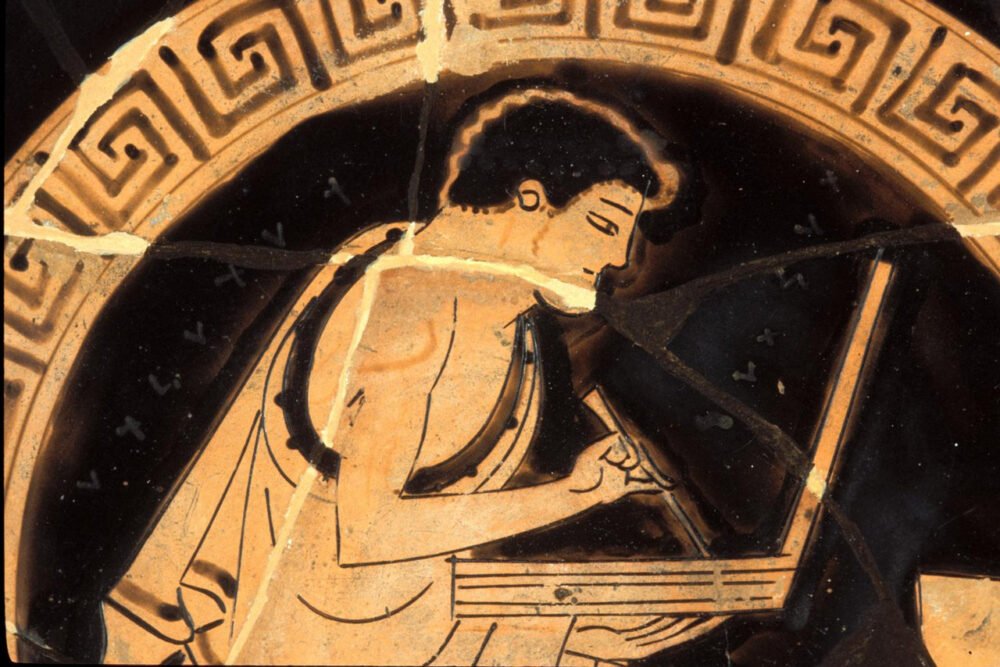
Education in ancient Athens
In ancient Athens, the purpose of education was to produce citizens trained in the arts, to prepare citizens for both peace and war. Girls were not educated at school, but many learned to read and write at home, in the comfort of their courtyard. Other than requiring two years of military training that began at age 18, the state left parents to educate their sons as they saw fit.
The schools were private, but the tuition was low enough so that even the poorest citizens could afford to send their children for at least a few years. Until age 6 or 7, boys were taught at home by their mother or by a male slave. Later, in the fourth century B.C. in some cities public schools were open that were available to poor.
Boys Education in ancient Athens
Boys in Athens attended elementary school from the time they were about age 6 or 7 until they were 13 or 14. Part of their training was gymnastics.
The younger boys learned to move gracefully, do calisthenics, and play ball and other games. The older boys learned running, jumping, boxing, wrestling, and discus and javelin throwing. The boys also learned to play the lyre and sing, to count, and to read and write. But it was literature that was at the heart of their schooling.
The national epic poems of the Greeks – Homer’s Odyssey and Iliad – were a vital part of the life of the Athenian people. As soon as their pupils could write, the teachers dictated passages from Homer for them to take down, memorize, and later act out. Teachers and pupils also discussed the feats of the Greek heroes described by Homer.
The education of mind, body, and aesthetic sense was, according to Plato, so that the boys “may learn to be more gentle, and harmonious, and rhythmical, and so more fitted for speech and action; for the life of man in every part has need of harmony and rhythm.”
From age 6 to 14, they went to a neighborhood primary school or to a private school. Books were very expensive and rare, so subjects were read out-loud, and the boys had to memorize everything. To help them learn, they used writing tablets and rulers.
Education in ancient Sparta
The goal of education in Sparta, an authoritarian, military city-state, was to produce soldier-citizens. In ancient Sparta, the purpose of education was to produce a well-drilled, well-disciplined marching army. Spartans believed in a life of discipline, self-denial, and simplicity. They were very loyal to the state of Sparta.
Every Spartan, male or female, was required to have a perfect body. When babies were born in ancient Sparta, Spartan soldiers would come by the house and check the baby. If the baby did not appear healthy and strong, the infant was taken away, and left to die on a hillside, or taken away to be trained as a slave (a helot). Babies who passed this examination were assigned membership in a brotherhood or sisterhood, usually the same one to which their father or mother belonged.
Boys Education in ancient Sparta
The boys of Sparta were obliged to leave home at the age of 7 to join sternly disciplined groups under the supervision of a hierarchy of officers. From age 7 to 18, they underwent an increasingly severe course of training.
Spartan boys were sent to military school at age 6 or 7. They lived, trained and slept in their the barracks of their brotherhood. At school, they were taught survival skills and other skills necessary to be a great soldier. School courses were very hard and often painful. Although students were taught to read and write, those skills were not very important to the ancient Spartans.
Only warfare mattered. The boys were not fed well, and were told that it was fine to steal food as long as they did not get caught stealing. If they were caught, they were beaten. They boys marched without shoes to make them strong. It was a brutal training period.
At 18, Spartan boys became military cadets and learned the arts of war. At 20, they joined the state militia–a standing reserve force available for duty in time of emergency–in which they served until they were 60 years old.
The typical Spartan may or may not have been able to read. But reading, writing, literature, and the arts were considered unsuitable for the soldier-citizen and were therefore not part of his education. Music and dancing were a part of that education, but only because they served military ends.
Girls Education in ancient Sparta
Unlike the other Greek city-states, Sparta provided education for girls that went beyond the domestic arts. The girls were not forced to leave home, but otherwise their training was similar to that of the boys. They too learned to run, jump, throw the javelin and discus, and wrestle mightiest strangle a bull.
Somewhere between the age of 18-20, Spartan males had to pass a difficult test of fitness, military ability, and leadership skills.
Any Spartan male who did not pass these examinations became a perioikos. (The perioikos, or the middle class, were allowed to own property, have business dealings, but had no political rights and were not citizens.)
If they passed, they became a full citizen and a Spartan soldier. Spartan citizens were not allowed to touch money. That was the job of the middle class. Spartan soldiers spent most of their lives with their fellow soldiers.
They ate, slept, and continued to train in their brotherhood barracks. Even if they were married, they did not live with their wives and families. They lived in the barracks. Military service did not end until a Spartan male reached the age of 60. At age 60, a Spartan soldier could retire and live in their home with their family.
Read more: