Greece Index
Find Places of Interest, Hotels, Apartments, Restaurants, Car Rental and Services in Greece
Greece Index
Find Places of Interest, Hotels, Apartments, Restaurants, Car Rental and Services in Greece
Greek Drachma, Ancient and Modern Drachma
Ancient Drachma
Herodotus mentions that the first coins were minted in Lydia in Asia Minor in the 7th century BC and were made of a mixture of gold and silver. About a century later, the drachma as a word, a coin and a value was imposed in Greece, as a replacement of the obol, by Pheidon, the king of Argos.
The word “drachma” comes from the verb “drattomai”, meaning “to grasp what fits in one’s palm”. A bundle of six oboloi (copper or iron rods) could be held in the palm of the hand, so one drachma was equivalent to six obols.
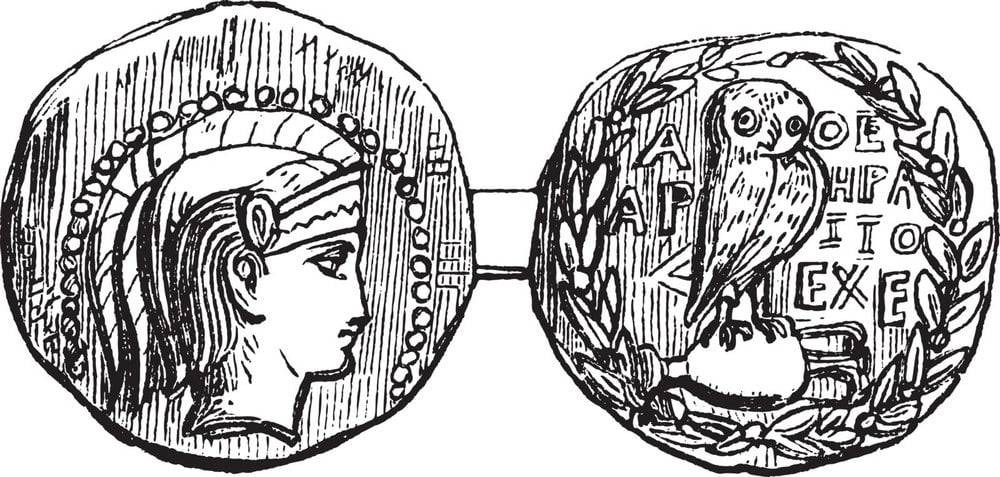
Greek coins of the time depict symbols of the various city-states. Aegina chose the marine turtle, Corinth its foals, while Athens honored its protectress: the drachma of the 5th century BC bore the head of the goddess Athena on one side and her sacred owl on the other.
In ancient Greece, the weight of a silver drachma varied from place to place. The Aeginean or Pheidonian coin weighed 6.06 grams, the Phoenician-Rhodian coin ranged between 3.64 and 7.28, while the Euboean-Attic drachma varied from 4.366 to 8.73 grams. Checking for counterfeit coins was widespread.
Athenian drachmas, known as silver “owls”, dominated the ancient world for about 600 years. In 456 BC, Athens even forced the defeated Aegina to stop minting its own “turtles” and use Athenian owls, while in 449 BC the powerful city-state demanded that all foreign coins be surrendered to the authorities.
However, the Athenian attempt to impose their own coin was unsuccessful, as the other city-states began to mint their own coins again, while in 407 BC a decisive Spartan victory in the Peloponnesian War deprived Athens of the precious silver mines.
Over the course of centuries, the Athenian drachma gave way to hundreds of different types of coinage, established by various rulers, kings, emperors and conquerors. With the passage of time, human mastery of the world and self-confidence was confirmed and stamped on coins, culminating in Hellenistic coins on which the Gods of Olympus were replaced by Alexander the Great, followed by his crowned generals.
Modern Greek Drachma
The modern Greek drachma was introduced in 1832 as the official currency of Greece (link) after the country gained independence. The modern drachma had different denominations of coins and banknotes, featuring different designs that represented Greek culture, history, and notable figures.

During its existence, the modern Greek drachma faced several challenges, including high rates of inflation and economic instability. For example, in the 1940s and 1950s, Greece experienced significant inflation, which led to the devaluation of the drachma. The revaluation of the drachma in 1954 was intended to stabilize the currency and restore confidence in the Greek economy.
However, despite efforts to maintain stability, the Greek drachma continued to face economic challenges in the late 20th century. The country’s debt crisis, which began in the late 2000s, led to a loss of confidence in the Greek economy and its currency.
Greek Drachma Coins
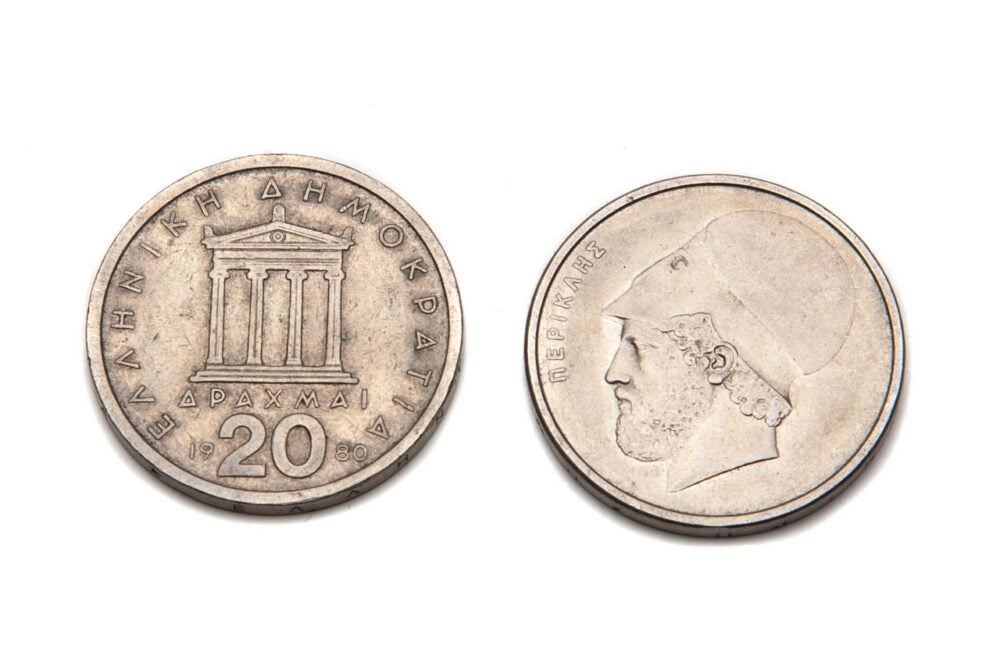
Greek drachma coins were minted in various denominations, such as 1, 2, 5, 10, 20, and 50 drachmae, with each denomination featuring different designs. Special commemorative coins were issued to honor significant events and championships in Greece. In 2004, Greek drachma coins ceased to be legal tender and were no longer exchanged for euros.
The designs of Greek drachma coins often featured Greek mythology, historical figures, and significant landmarks. For example, the 1 drachma coin featured an image of Athena, the goddess of wisdom and courage, while the 50 drachma coin depicted an ancient Greek athlete. These designs not only reflected Greece’s rich cultural heritage, but also served as a source of national pride for the Greek people.
In addition to their monetary value, Greek drachma coins have historical and numismatic significance. Many collectors and enthusiasts value these coins for their artistry and historical context. They offer a glimpse into the economic and cultural history of Greece and provide a tangible link to the past.
For example, the 20-drachma coin issued in 2000 featured an image of Pericles, a prominent Statesman and General in ancient Athens. This coin commemorated the 2500th anniversary of the birth of democracy in Athens and served as a tribute to the democratic ideals that originated in Greece. The issuance of commemorative coins such as this, not only celebrated Greece’s rich history, but also contributed to the promotion of Greek culture and heritage.
Link: pdf with the last drachma coins in circulation
Greek Drachma Banknotes
Banknotes were introduced for the Greek drachma, with artists and engravers creating the designs. Greek drachma banknotes depicted various historical and cultural themes, showcasing Greece’s rich heritage.
The banknotes featured prominent figures from Greek history and mythology, such as Socrates, Aristotle and Zeus. The designs aimed to capture the essence of Greek culture and its contributions to philosophy, democracy and mythology. The intricate artwork and attention to detail on the banknotes made them not only a medium of exchange, but also works of art that reflected Greece’s cultural identity.
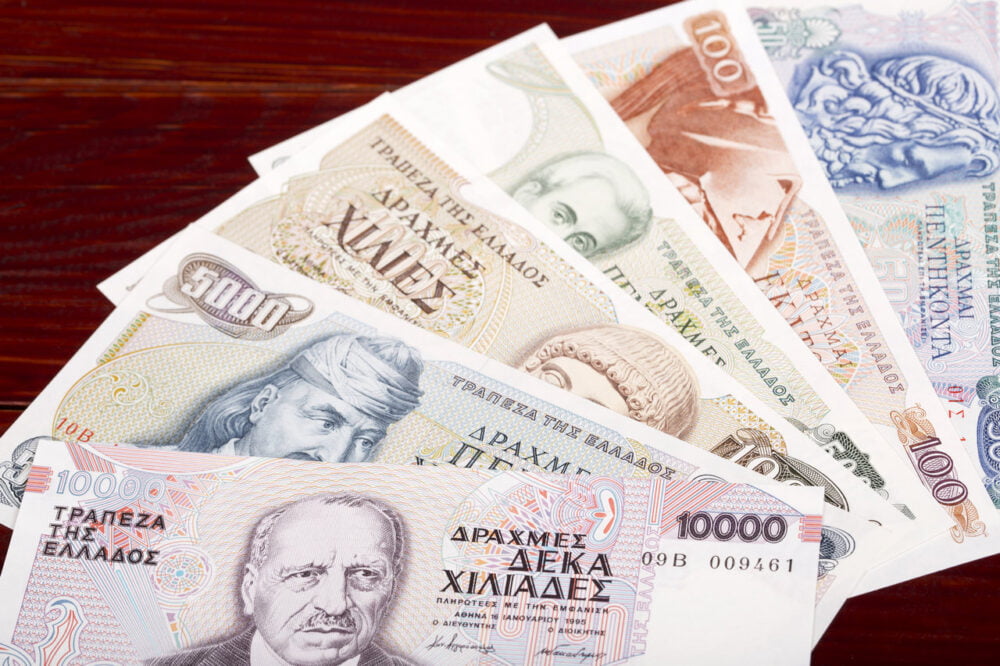
For example, the 1000 drachma banknote issued in 1987 featured an image of Democritus, an ancient Greek philosopher known for his theory of atomism. This banknote symbolized Greece’s intellectual heritage and its significant contributions to the field of philosophy and scientific thought.
Link: pdf with the last circulating banknotes
The banknotes also featured important landmarks and monuments, such as the Parthenon and the Temple of Apollo. These images served as a reminder of Greece’s architectural achievements and its historical significance as the birthplace of Western civilization.
The introduction of Greek drachma banknotes not only facilitated everyday transactions, but also promoted Greek culture and history. The intricate designs and artistic elements on the banknotes made them not only a medium of exchange, but also a source of national pride for the Greek people.
Conversion from the Greek Drachma to the Euro
The changeover from the Greek drachma to the euro took place on January 1, 2002, with the introduction of euro banknotes and coins in Greece. Drachma banknotes and coins ceased to be legal tender on February 28, 2002. This changeover had significant economic implications for Greece, affecting areas such as trade, investment and monetary policy.
The adoption of the euro brought Greece into the euro zone, a monetary union of several European countries. This meant that Greece had to align its monetary policy with that of the European Central Bank (ECB) and abide by the rules and regulations set by the Eurozone. The goal of this integration was to promote economic stability and facilitate trade and investment among eurozone countries.
The transition from the drachma to the euro marked a new era for Greece, with significant implications for its economy and society. While the adoption of the euro brought benefits such as stability and greater integration with the European Union, it also meant the loss of a currency that had been a symbol of Greek identity for centuries.
Although the Greek drachma is no longer in circulation, its historical and cultural significance remains. It serves as a reminder of Greece’s rich heritage and its contributions to the arts, philosophy and democracy. The legacy of the drachma continues to be celebrated and remembered, demonstrating the enduring impact of Greece’s ancient and modern currency.
Read more: